Wuhan Zonke Optoelectronic Technology Co., Ltd.

News Center
[ZKKL] Academic Presentation | Clinical Efficacy of Radiofrequency Combined with Hydroxychloroquine in the Treatment of Facial Sensitive Skin, as Observed by Shu Min’s Star
Release time:2019-12-24

Article reprinted from: Journal of Shanxi Medical University
Authors: Lu Wanjiao, Wang Lumei, Li Junjie, Zhang Bin
[Abstract] Objective: To investigate the clinical efficacy of Shuminzhixing radiofrequency combined with hydroxychloroquine in treating facial sensitive skin. Methods: A total of 98 patients with facial sensitive skin were randomly divided into two groups. Both groups received topical moisturizing therapy (Shumin Moisturizing Agent) twice daily as standard skincare. The control group was administered oral hydroxychloroquine sulfate tablets, 0.2 g twice daily; the radiofrequency group, in addition to oral hydroxychloroquine, underwent Shuminzhixing radiofrequency‑mediated delivery of the moisturizing agent: once every 3 days during weeks 1–2, and once weekly during weeks 3–4. The treatment course lasted 4 weeks, with efficacy assessed at weeks 1, 2, and 4. Results: At the end of weeks 1, 2, and 4, the effective rates in the radiofrequency group were 48.97%, 73.47%, and 89.80%, respectively, all significantly higher than those in the control group (16.33%, 30.61%, and 38.76%, respectively). These differences were statistically significant (P < 0.05).
Conclusion: On the basis of topical moisturizer therapy, the combination of Sensi‑Star radiofrequency and hydroxychloroquine significantly enhances the clinical efficacy in patients with facial sensitive skin, outperforming hydroxychloroquine alone, and is therefore worthy of clinical adoption.
[Keywords] Radiofrequency; hydroxychloroquine; sensitive skin.
Facial sensitive skin is often caused by long-term topical corticosteroid use [1], and by undergoing… Poor skincare practices, inadequate post‑laser treatment care [2], and other factors can compromise the skin’s lipid barrier and its… Brick wall structure It is a series of immune‑mediated inflammatory responses that arise when the skin barrier is compromised, leading to reduced barrier function and impaired tolerance to external irritants.
Clinically, it often manifests as recurrent facial desquamation, erythematous papules, and dryness, accompanied by symptoms such as pruritus, burning, tightness, and intolerance to heat and cold [3], frequently causing significant distress to patients. Its pathogenesis is complex, with impaired skin barrier function being one of the key etiological factors [4, 5]. Hydroxychloroquine has demonstrated favorable clinical efficacy in the treatment of facial sensitive skin [6]; however, current clinical practice indicates that relying solely on this medication combined with topical moisturizers is insufficient to achieve rapid symptom relief, restore the skin barrier, or shorten the disease course.
Soothing Star Radiofrequency technology, owing to its potent hydrating effects and ability to facilitate the delivery of moisturizing agents, can effectively promote the repair of sensitive skin [7]. Accordingly, in this study, on the basis of topical moisturizer use, we employed radiofrequency therapy combined with hydroxychloroquine to treat facial sensitive skin, achieving satisfactory clinical outcomes, which are reported herein.
Preface -
Materials and Methods
1.1 Inclusion and Exclusion Criteria
Inclusion criteria: ① Meeting the diagnostic criteria for facial sensitive skin [4]: a history of long-term topical corticosteroid use, use of substandard cosmetics, or frequent improper cosmetic procedures; recurrent erythema, papules, dryness, and scaling on the face, potentially accompanied by epidermal thinning and telangiectasia; and subjective symptoms including varying degrees of stinging, burning, tightness, and pruritus.
Patients aged 18 to 60, regardless of gender. ③ Willing to accept This treatment protocol. This study was approved by the Ethics Committee of our hospital, and all enrolled patients signed informed consent prior to treatment. “Informed Consent for Shumin Star Treatment.”
Exclusion criteria:
① Subjects with seborrheic dermatitis, acne, or other conditions that may affect the assessment of treatment efficacy;
② Pregnant and lactating women;
③ Patients with severe cardiovascular, renal, hepatic, endocrine, or other systemic diseases, or those suffering from neoplastic or immunodeficiency disorders;
④ Throughout the entire study period, it cannot be guaranteed that participants will refrain from using other products of the same type, receiving alternative treatments (e.g., anti-allergic agents, glucocorticoids, immunosuppressants, etc.), or avoiding spicy and sweet foods and alcohol.
⑤ Subjects who discontinued treatment due to adverse reactions or other reasons.
1.2 General Information
A total of 98 patients met the inclusion criteria and were enrolled in the treatment observation, including 16 males and 82 females. Among them, 60 cases were attributable to hormone-dependent dermatitis, 20 to cosmetic‑induced dermatitis, 9 to post‑laser dermatitis, and 9 to idiopathic sensitive skin. The patients’ ages ranged from 18 to 56 years, with a mean age of 34.84 ± 11.65 years; the disease duration varied from 2 months to 6 years, averaging 6.8 months. Patients were randomly assigned, in order of presentation, to either the control group or the radiofrequency group, with 49 patients in each group. There were no statistically significant differences between the two groups in terms of age, sex, disease duration, or severity of skin lesions (P > 0.05), indicating that the groups were comparable.
1. 3 Treatment Methods
Both the control group and the radiofrequency group received topical moisturizing agents (a soothing, hydrating cream) twice daily—morning and evening—as standard skincare therapy for this condition. The control group was administered oral hydroxychloroquine sulfate (trade name: Fenle, Shanghai Zhongxi Pharmaceutical Co., Ltd.) at 0.2 g twice daily; the radiofrequency group, in addition to the control regimen, underwent radiofrequency treatment using the Shumin Zhi Xing device to deliver the moisturizing agent for 30 minutes—three times per week during weeks 1 and 2, and once weekly during weeks 3 and 4—over a total treatment course of 4 weeks. Procedure: Operate according to the instructions provided with the Shumin Zhi Xing radiofrequency device. Prior to treatment, thoroughly cleanse the entire facial skin and apply the moisturizing agent to the target areas. Gently press the treatment handpiece against the treatment site, ensuring perpendicular coupling with the skin. Treatment is performed in an upward‑and‑outward direction, following the natural lines of the facial skin. During the session, mist mineral water onto the face, employing circular motions and gentle pressure.
1.4 Criteria for Evaluating Treatment Efficacy
Changes in clinical status were observed and recorded before and after treatment, including the presence or absence of adverse effects from radiofrequency therapy, subjective symptoms (such as burning, itching, pain, and a sensation of tightness), and objective signs (assessed by a designated evaluator: skin erythema or edema, papules, pustules, dryness, scaling, hyperpigmentation, skin atrophy, and telangiectasia). Each item was graded on a 4-point scale—0 = none, 1 = mild, 2 = moderate, 3 = severe. The efficacy index was calculated as follows: (pre‑treatment score − post‑treatment score) / total pre‑treatment score × 100%. A cure was defined as an efficacy index ≥95%; marked improvement, 60%–94%; improvement, 20%–59%; and no effect, <20%. The overall effective rate was computed by summing the proportions of patients achieving cure and marked improvement [6]. Adverse reactions to hydroxychloroquine: Patients in both the control and treatment groups underwent routine blood and urine tests, liver and kidney function assessments, and ophthalmologic examinations at baseline, and at 2 and 4 weeks post‑treatment.
1.5 Statistical Analysis
Statistical analysis was performed using SPSS 13.0 software, and comparisons of the effective rate were conducted using… The χ² test was used, with P < 0.05 considered statistically significant.
-
2
-
Result
2.1 Clinical Efficacy
The overall clinical treatment outcomes of the two patient groups are shown in Table 1. Treatment for 1 week Subsequently, the efficacy rate in the radiofrequency group was higher than that in the control group, with a statistically significant difference between the two groups (48.97% vs. 16.33%, χ² = 4.61, P < 0.05; see Table 1). After 2 weeks of treatment, the efficacy rate in the radiofrequency group remained higher than that in the control group, with a statistically significant difference (73.47% vs. 30.61%, χ² = 3.81, P < 0.05; see Table 2). At 4 weeks of treatment, the efficacy rates were 89.80% in the radiofrequency group and 38.76% in the control group, again demonstrating a statistically significant difference (χ² = 4.16, P < 0.05; see Table 3). The radiofrequency treatment achieved favorable outcomes in patients with sensitive skin. Table 1: Comparison of Overall Clinical Efficacy Between the Two Groups After 1 Week of Treatment (n).
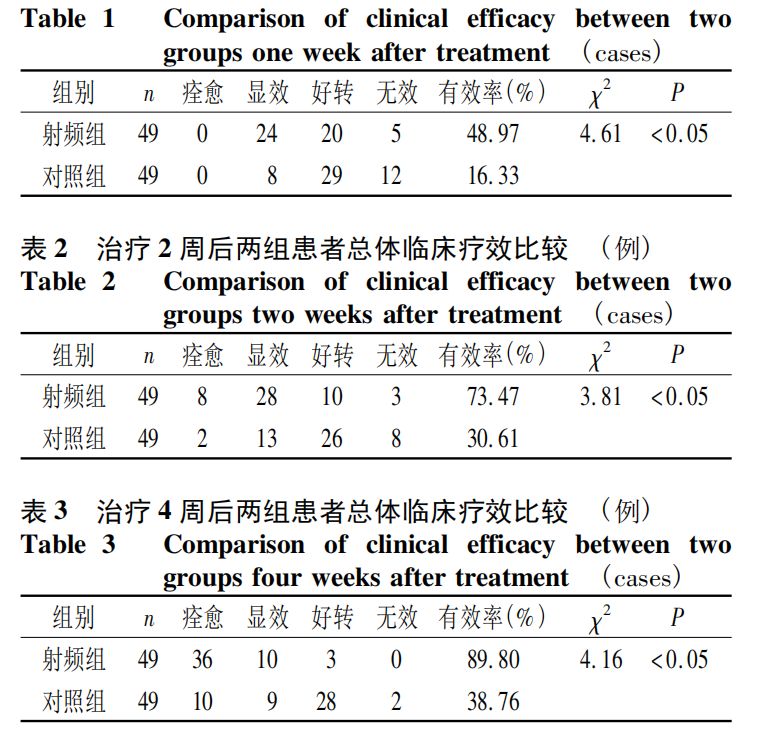
During the course of treatment, neither group experienced any serious adverse reactions. In the radiofrequency group, three patients reported mild discomfort—pruritus and burning—which improved with ice application; they proceeded to the next session without further issues. In the control group, 12 patients exhibited marked facial dryness, pain, and tightness at week 2; increasing the frequency and amount of topical soothing and moisturizing agents led to symptom improvement. Adverse reactions to hydroxychloroquine: Among the 49 patients in the control group, 3 experienced mild nausea and abdominal discomfort, while in the treatment group, 1 patient reported similar symptoms; these occurred 1–2 weeks after initiation of therapy, did not necessitate discontinuation of treatment, and resolved spontaneously. Hematologic and urinalysis results, as well as liver and renal function tests, were normal before treatment and at 2 and 6 weeks post‑treatment in both groups. Fundoscopic examinations performed before treatment and at 2 and 4 weeks post‑treatment revealed no abnormalities in either group.
-
3
-
Discussion
Facial sensitive skin manifests as Diffuse erythema, desquamation, edema, Acne‑like rashes, accompanied by marked pruritus and burning sensations, ultimately lead to telangiectasia, skin atrophy, and hyperpigmentation, severely compromising the patient’s physical and mental well-being.
At present, the pathogenesis remains incompletely understood and is likely associated primarily with four factors: impaired skin barrier function, vascular and neural hyperreactivity, and microbial infection [4, 5]. Therefore, the author believes that, to achieve effective treatment, shorten the disease course, and substantially alleviate patients’ physical and psychological distress, a comprehensive therapeutic approach is warranted. The main components of this approach are as follows:
① Identify the underlying cause: if the condition is due to long-term topical corticosteroid use or unsuitable skincare products, discontinue these immediately and initiate a safe tapering regimen, while providing psychological counseling.
② Secondly, to suppress the inflammatory response, medications such as hydroxychloroquine and glycyrrhizin may be administered.
③ To promote the repair of the damaged skin barrier, medical skincare products such as soothing, moisturizing, and reparative agents may be administered. To facilitate skin barrier recovery, both the control group and the radiofrequency group in this study were treated topically with a soothing, moisturizing agent as a standard moisturizing and skin‑care intervention.
On this basis, the present study demonstrates that hydroxychloroquine exhibits favorable efficacy in the treatment of facial sensitive skin, with the response rate gradually increasing over the course of therapy; at 1, 2, and 4 weeks of treatment, the response rates were 16.33%, 30.61%, and 38.76%, respectively. Hydroxychloroquine is currently a cornerstone medication for the clinical management of systemic lupus erythematosus and is also widely recognized in dermatology as the first-line agent for treating facial sensitive skin.
Research has shown that hydroxychloroquine reduces cutaneous sensitivity to ultraviolet radiation, stabilizes lysosomal membranes, inhibits the binding of denatured DNA to antibodies, and suppresses cellular immunity and complement activation [8]. Furthermore, in vitro studies have demonstrated that hydroxychloroquine can inhibit the proliferation and differentiation of CD4+ Foxp3+ Treg cells [9]; therefore, it is hypothesized that it may also exert its anti‑inflammatory effects in facial sensitive skin via this mechanism.
Shumin Zhi Xing, also known as the KL-DB shortwave therapeutic device. , The underlying principle relies on radiofrequency electric field therapy combined with computer and electronic technologies. Insulating electrodes are positioned close to the skin surface, delivering energy in the form of a radiofrequency electric field into the subcutaneous tissues. Through ionization and osmotic penetration, the treatment electrolyzes water molecules at the skin’s surface into ionic forms; owing to the repulsion between like‑charged ions, these ions can rapidly traverse intercellular ion channels and reach the basal layer of the epidermis, thereby replenishing the skin with moisture. Radiofrequency energy also stimulates the repair of keratinocyte function, restores the skin’s brick‑and‑mortar structure, and reinforces the skin barrier. During the procedure, the oxygen released promotes cutaneous blood circulation and facilitates the metabolism and absorption of inflammatory mediators, thus achieving anti‑inflammatory and antibacterial effects [7].
Therefore, leveraging the exceptional penetration efficacy of the Shuminzhixing device, this study employed it to deliver a medical skincare product with excellent reparative and moisturizing properties—Shumin Moisturizing Agent—into damaged skin, in order to evaluate the therapeutic effectiveness of this technique for treating facial sensitive skin. The results showed that, at weeks 1, 2, and 4 of treatment, the radiofrequency group exhibited significantly higher response rates (48.97%, 73.47%, and 89.80%, respectively) compared with the control group (16.33%, 30.61%, and 38.76%, respectively), with all differences reaching statistical significance (P < 0.05). Thus, on the basis of topical moisturizing skincare agents that repair the skin barrier, The clinical efficacy of the combination of Shuminzhixing radiofrequency technology and hydroxychloroquine is significantly superior to that of hydroxychloroquine alone. In our study, we found that most patients experienced immediate relief from common skin‑sensitivity symptoms—such as dryness, stinging, warmth, flushing, and tightness—following treatment. Moreover, owing to the technique’s non‑invasive nature, comfort, and rapid efficacy, it has been well received by patients with sensitive skin.
The superior efficacy of this technology compared to hydroxychloroquine alone may be attributed to the ultra‑strong ionization principle of Shumin Zhi Xing, which enhances its penetrating power. This enables the soothing and moisturizing agent to rapidly and effectively penetrate deep into the skin’s basal layer, delivering immediate anti‑inflammatory, hydrating, and barrier‑repairing benefits. The Shuminzhixing radiofrequency technology employed in this study has been well received by a broad patient population. This technique merits clinical adoption and wider dissemination.
References:
[1] Zhang Bin, Zheng Shuangjin. Clinical Treatment of Skin Sensitivity Following Hormone-Dependent Dermatitis Therapy
[J]. Chinese Journal of Continuing Medical Education, 2016, 8(8): 184–185.
[2] Cai Wei, He Li. Advances in Research on Sensitive Skin [J]. Dermatology and Venereology, 2015, 16(3): 88–91.
[3] Wang Xianfen. Exploring the therapeutic value of pimecrolimus cream for facial sensitive skin in women.
[J]. Chinese Journal of Medical Aesthetics, 2016, 6(4): 56–58.
[4] Wu Yanyu, Wang Xuemin. Testing and Evaluation of Sensitive Skin [J]. Chinese Journal of Medical Aesthetics and Beauty, 2014, 15(4): 177–180.
[5] Li Chunlian. Research progress on the etiology of sensitive skin [J]. Chinese Journal of Integrated Traditional Chinese and Western Medicine in Dermatology and Venereology, 2015, 24(4): 111–114.
[6] Ma Jiamin. Clinical observation on the efficacy of butyl flufenamate cream in treating facial corticosteroid-dependent dermatitis [J]. Chinese Journal of Dermatology and Venereology, 2009, 23(12): 851–852.
[7] Yang Hongqiu, He Guohui, Deng Ying, et al. Clinical efficacy observation of Shuminzhixing combined with red light therapy for facial hormone-dependent dermatitis [J]. Southwest Military Doctor, 2017, 19(5): 424–427.
[8] Costedoat-Chalumeau N, Dunogué B, Morel N, et al. Hydroxychloroquine: a multifaceted treatment in lupus [J]. Presse Med, 2014,
43( 6Pt2) : e167 - 180.
[9] Yang Ji, Yang Xue, Yang Jie, et al. Regulatory effects of hydroxychloroquine on the in vitro differentiation of regulatory T cells [J]. Chinese Journal of Dermatology, 2016, 49(7): 504–505.
Note: This article is intended for academic exchange only and may not be used for commercial purposes. Copyright belongs to the original author; if any infringement occurs, please contact us immediately, and we will address it promptly.
Related News

Enquire now
If you have any questions, please contact us immediately and we will respond as soon as possible
You can also follow us on social media
WhatsApp:
在线客服添加返回顶部
页面顺滑的滚动
右侧在线客服样式 1,2,3 1
图片alt标题设置: Wuhan Zonke Optoelectronic Technology Co., Ltd.
表单验证提示文本: Content cannot be empty!
循环体没有内容时: Sorry, no matching items were found.
CSS / JS 文件放置地